
Construction
of clay tennis courts
Building a tennis court is much more than just spreading clay. It’s about understanding how each element works and how it integrates into the whole. At Greencourt, we meticulously manage each phase of the process to ensure the result is solid, durable, and optimal for play.
AENOR certifies Greencourt’s environmental leadership, by certifying its first carbon footprint analysis according to ISO 14067:2018. A pioneering project based on LCA that positions Greencourt at the forefront of decarbonization and sustainability in tennis court construction.
Features of clay tennis courts
Drainage and Slopes
We ensure that each court drains water efficiently, adapting the slope according to the terrain configuration and project needs:
Single-slope courts, where the entire slope directs water towards one side.
Double-slope courts, where the slope is distributed towards the court baselines.
Four-slope courts, where water is directed towards the four corners, like an inverted pyramid.
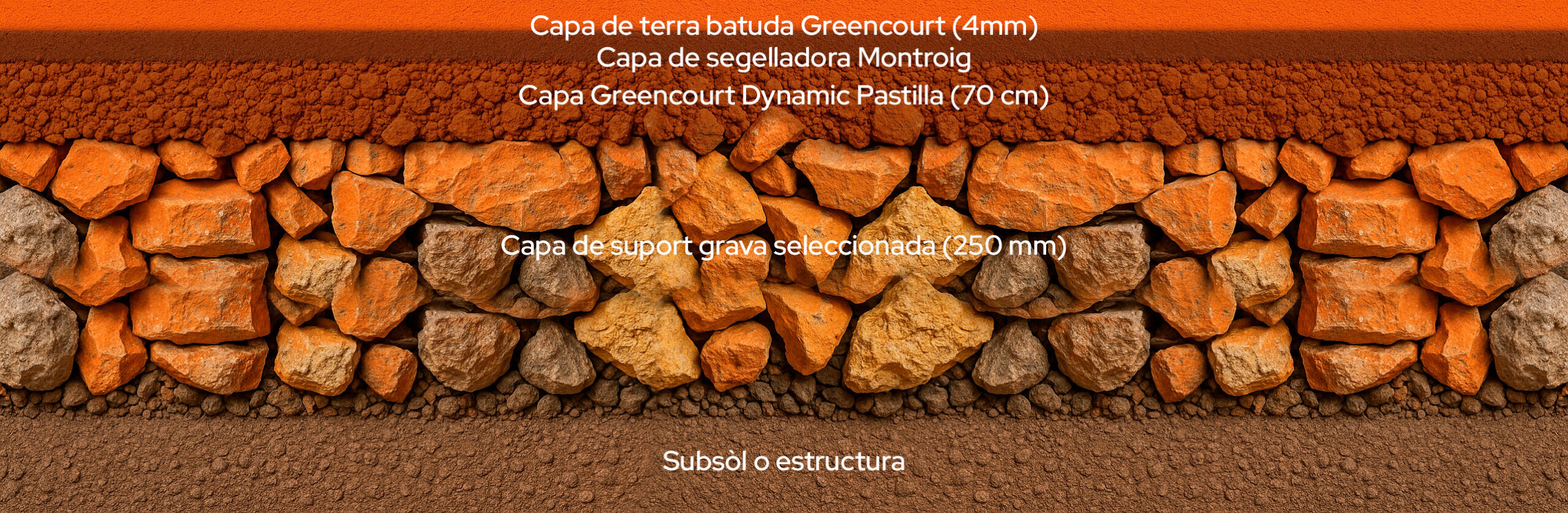
Subsoil and Support Layer
Everything begins with a solid base. We ensure the ground is perfectly clean and compacted to guarantee the stability of the entire structure. On this subsoil, we place the support layer, typically made of ceramic aggregate —crushed brick— or, in some cases, recycled gravel. This layer acts as drainage and naturally provides moisture to the court.
Greencourt Dinamic® Compound
The core of our court. The Dinamic® compound, patented by Greencourt (Invention Patent No. 200200330), is an exclusive blend of selected aggregates that ensure high compaction, efficient drainage, and moisture retention during playing hours. This proprietary formula allows us to offer a stable, comfortable, and highly durable surface.
Montroig Court Sealing Layer
To protect the compound, we apply a sealing layer with Montroig clay (90% silica). This layer prevents fractures caused by intense play and helps to better retain moisture. Furthermore, it facilitates regular court maintenance and improves its performance over time.
Red Court Clay
The final layer is what gives the court its character. We use ground brick clay, which provides optimal cushioning, promotes smooth movement, and naturally absorbs moisture. At Greencourt, we work with different granulometries (0.1 / 1.5 / 0.2 mm) to adapt to each court and playing style.
Court Lines
We install lines that adapt to the court and climate conditions:
Cement lines: with a smooth and non-slip surface, manufactured with cement and galvanized iron rods.
PVC lines: in perforated rolls, installed with tensioners. They are resistant to cold and rain, but can slightly expand and deform over time.
Carbon Footprint Calculation
Calculating the carbon footprint of our clay courts represents another step in our firm commitment to reduce greenhouse gas emissions and promote material circularity.